Peptides for Research: Supply Standards, Purity Documentation, and the NZ Landscape
By Southern Labs Research Team · Published 2026-08-04

The quality of peptides used in research settings can make or break experimental outcomes, yet sourcing decisions are often treated as an afterthought. For laboratories operating within New Zealand's regulatory environment, the stakes are particularly high. Inconsistent purity levels, inadequate documentation, and unreliable supply chains introduce variables that compromise reproducibility and waste valuable resources.
This analysis examines the critical standards governing peptide procurement for research purposes, with a specific focus on purity documentation requirements and the unique logistical considerations facing NZ-based researchers. Whether you are sourcing custom synthesised sequences or catalogue peptides for assay development, understanding what separates a reliable supplier from a problematic one requires more than a cursory review of a product page.
Readers will come away with a clearer framework for evaluating supplier credentials, interpreting analytical certificates, and navigating the practical realities of importing research-grade materials into New Zealand. The discussion draws on established quality benchmarks from the field and addresses how local regulatory nuances intersect with international supply standards. If peptide quality directly influences your research integrity, this breakdown is worth your attention.
What Peptides Are in a Research Context
Peptides are short-chain molecules composed of amino acids connected by covalent peptide bonds, the same bond type that forms the structural backbone of all proteins. In laboratory classification, a peptide is conventionally defined as containing between 2 and 50 amino acid residues, which distinguishes it structurally from the larger polypeptide chains and full proteins that dominate other areas of biochemical research. This numerical boundary is not entirely rigid; some classification frameworks extend it to 100 residues depending on molecular weight and folding behaviour. The more meaningful distinction is functional: peptides are small enough to be synthesised chemically with precision, making them tractable as discrete, reproducible research tools in ways that larger proteins are not.
Synthesis: How Research Peptides Are Made
Synthetic peptides used in laboratory settings are manufactured through controlled chemical processes rather than biological expression systems. The dominant method is Solid Phase Peptide Synthesis (SPPS), which currently accounts for 63.0% of global synthesis method market share (Future Market Insights, 2026). In SPPS, the peptide chain is assembled sequentially on an insoluble resin support, with individual amino acid residues added one at a time through cycles of coupling and deprotection before the completed chain is cleaved and purified. The American Peptide Society's SPPS primer identifies this technique as the foundational method for peptide research, requiring working knowledge of organic chemistry and familiarity with standard laboratory safety protocols. Active refinement of the technique continues; a 2025 study published in the Journal of Biomedical Materials Research at the University of Rochester introduced a rapid manual SPPS protocol specifically optimised for high-throughput peptide library production, reflecting ongoing demand for faster and more scalable synthesis pipelines.
Research Applications and the Regulatory Distinction
Synthetic peptides serve a broad range of non-therapeutic laboratory functions, including structural biology investigations, cell signalling studies, enzymatic assay development, metabolic pathway research, and the production of reference standards for analytical work. These applications are defined by investigational intent, not clinical outcome. Research-grade synthetic peptides occupy a structurally and regulatorily distinct category from pharmaceutical or therapeutic peptides; they are not approved medicines, are not intended for human or animal administration, and are procured exclusively for controlled laboratory investigation. The "for research use only" designation carries a specific compliance meaning: the compound is supplied without the manufacturing controls, clinical validation, or regulatory approval required for medicinal use.
The consumable nature of peptides in research settings is reflected in market data. Reagent-grade peptides hold 46.0% of the leading product segment in the global peptide synthesis market (Future Market Insights, 2026), the single largest category by volume. This figure underscores that the primary demand driver for synthetic peptides globally is their utility as laboratory reagents, tools consumed during experimentation, rather than as formulated end-use compounds. For laboratory purchasers, this framing is directly relevant to procurement decisions: purity grade, identity verification, and batch-to-batch reproducibility matter more than any other product attribute.
The Research Peptide Supply Landscape in 2026
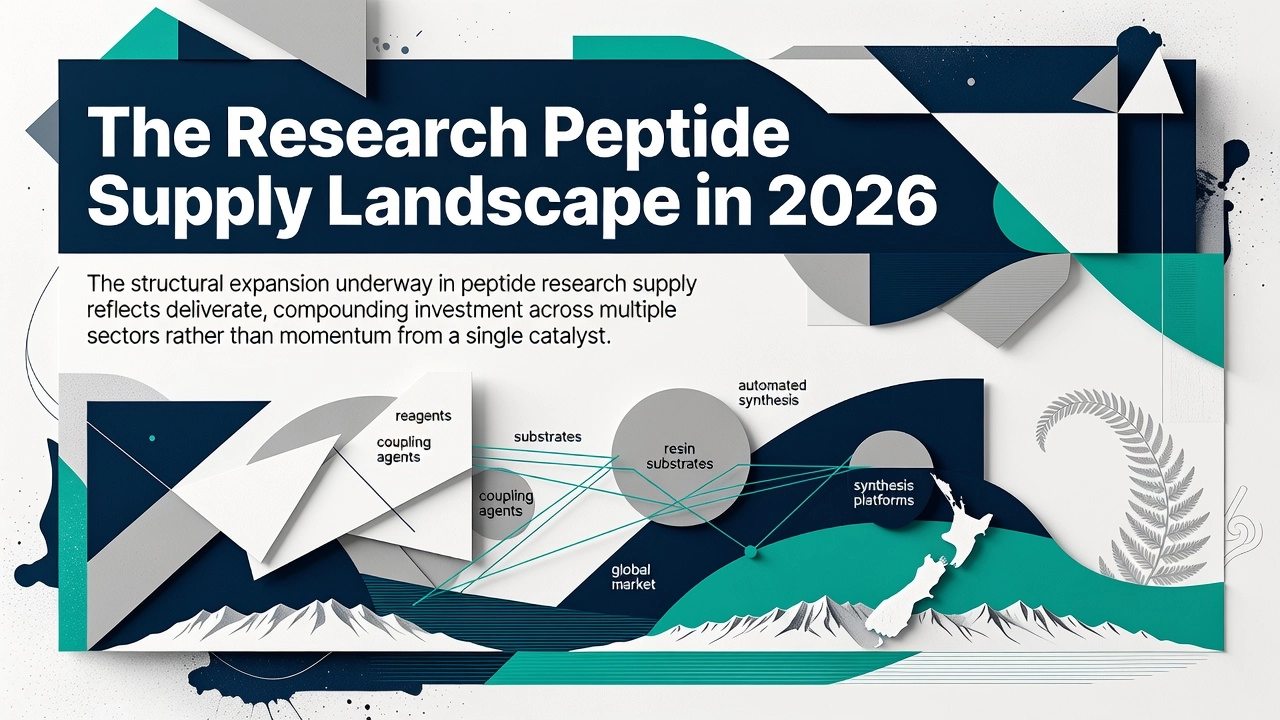
The structural expansion underway in peptide research supply reflects deliberate, compounding investment across multiple sectors rather than momentum from a single catalyst. The global peptide synthesis market, covering reagents, coupling agents, resin substrates, automated synthesis platforms, and laboratory supply infrastructure, is valued at approximately USD 0.7 billion in 2026 and forecast to reach USD 1.4 billion by 2036 at a compound annual growth rate of 8.1% (Future Market Insights, 2026). Separate forecasting from SNS Insider places the synthesis market at USD 784.92 million in 2025, projecting USD 1,889.88 million by 2035 at a 9.22% CAGR, while Precedence Research estimates USD 1,438.78 million by 2035. Variance across these projections reflects differing scope definitions, but directional consensus is consistent: this is a market in sustained structural expansion, not speculative cycle growth. More than 630 active peptide-based clinical trials globally underpin that synthesis demand directly.
Contextualising Research Supply Against the Therapeutics Market
The synthesis market does not exist in isolation. The broader peptide therapeutics market is estimated at USD 59.92 billion in 2026, with projections reaching USD 130.69 billion by 2034 at a 10.24% CAGR (Market Data Forecast, 2026). Some alternative estimates, including figures from Grand View Research cited in industry commentary, place the 2026 market considerably higher at USD 163.98 billion, with growth to USD 294.58 billion by 2033. These divergences most likely reflect differences in what applications are included within scope. Regardless of which valuation frame is applied, the commercial scale of downstream peptide therapeutics creates direct, durable demand pressure on upstream research and synthesis infrastructure. Pharmaceutical pipelines require preclinical-grade reference compounds. Academic programmes investigating novel peptide scaffolds require verified research-grade material. The supply layer that Southern Labs operates within is not incidental to this growth trajectory; it is structurally integral to it.
Demand Drivers: Beyond the GLP-1 Effect
The commercial success of GLP-1 receptor agonists has generated a well-documented spillover effect across broader peptide research categories. TikTok search volume for the term 'peptide therapy' surged 459% in Q1 2026 (PeptIQ, 2026), and Reddit's r/Peptides community has crossed 180,000 members, figures that reflect how mainstream visibility of GLP-1 agents has translated into generalised research curiosity across compound classes. For laboratory buyers, this matters less as a consumer signal and more as an indicator of the volume of early-stage research queries now entering the pipeline. Compounds currently generating elevated discussion in research communities include BPC-157, TB-500, GHK-Cu, VK2735, amycretin, pemvidutide, mazdutide, and cosmetic peptides such as Argireline. This distribution is notable specifically because it spans tissue-signalling, metabolic, longevity, and topical application categories simultaneously, reflecting genuine diversification of research focus rather than concentration around a single compound class.
Generic Pipeline and Procurement Cost Trajectories
One structural shift with direct implications for laboratory procurement is the accelerating growth of the generic peptide segment. Innovative, patent-protected compounds held 80.08% of market type share in 2025, but generic peptides are projected to grow at a 9.4% CAGR as blockbuster patent protections expire across the forecast period. For research buyers, this trajectory is meaningful in practical terms: as off-patent peptide APIs enter broader synthesis and distribution, procurement costs for commonly studied reference compounds are expected to face downward pressure. Independent industry analysis has identified longevity research, metabolic signalling, and cellular biology as primary structural demand drivers for research-grade peptides in 2026, and these categories align closely with the compounds now transitioning into or approaching generic availability. Laboratory purchasers planning multi-year procurement strategy should account for this patent expiry cycle when evaluating supply agreements and pricing expectations across their compound libraries.
Why Purity Documentation Matters for Research Reproducibility

A Certificate of Analysis is a batch-specific laboratory document issued alongside a research compound that formally records three categories of information: compound identity, purity percentage, and the analytical methods used to generate those figures. The two methodologies considered non-negotiable in a credible COA are High-Performance Liquid Chromatography (HPLC) for purity quantification and mass spectrometry (MS) for identity confirmation. HPLC purity is expressed as the percentage of the main peak area relative to all detected impurities in the chromatogram. MS identity confirmation verifies that the observed molecular weight of the compound matches its theoretical mass, typically within a tolerance of ±1 Dalton. These two measurements address distinct questions and must be reported separately; a purity figure alone does not constitute identity verification, and a molecular weight match does not substitute for quantitative purity data. The batch or lot number on the COA must correspond directly to the identifier printed on the vial received; a COA referencing a different batch number does not apply to the material in hand, regardless of how complete the documentation appears.
The Distinction Between Third-Party and Supplier-Generated Documentation
The phrase "third-party COA" carries a specific meaning that is frequently misapplied in research compound supply. Third-party independent testing means the COA is produced by a laboratory that has no commercial relationship with the supplier, has not synthesised or processed the compound, and has no financial interest in the reported outcome. This is structurally different from supplier-generated or in-house documentation, where the entity reporting purity is the same entity selling the product. In-house documentation cannot be independently verified by the purchasing researcher; the analytical figures are unconfirmable without access to the original raw instrument data and the testing laboratory's records. The strongest standard currently available is testing conducted by an ISO/IEC 17025-accredited laboratory, the internationally recognised framework for testing laboratory competence. Where a COA does not name the external testing laboratory, does not state the testing date, or does not specify the analytical method used, it cannot be treated as independently verified documentation regardless of the purity figure cited. Reading a peptide Certificate of Analysis in 2026 now requires evaluating not just the numbers but the provenance of those numbers.
COA Transparency as a Methodological Issue
For research reproducibility, the quality of purity documentation is not a procurement preference; it is a methodological variable. When a researcher designs an experiment around a specific compound, the validity of any observed result depends on the assumption that the compound in the vial matches its label identity and purity specification. If the material contains uncharacterised impurities, the observed result may be attributable to those impurities rather than the compound under investigation. If the material is misidentified, the experiment is testing the wrong substance entirely. Enforcement actions in 2026 have demonstrated this is not a theoretical risk; documented cases have found products labelled as one compound containing entirely different active substances. Purity documentation functions as the only objective evidence that the label and the contents correspond, and where that evidence is absent or unverifiable, confounded results cannot be distinguished from valid ones.
Industry vendor analysis published in 2026 identifies COA transparency as having shifted from a competitive differentiator to a minimum baseline expectation among research buyers (Aurum Peptide Labs, 2026). Low-transparency sellers offering limited, inconsistent, or unverifiable documentation are now clearly distinguishable from research-focused suppliers with structured, accessible, batch-specific COA data. This shift reflects heightened buyer scrutiny across the research community, supported by the proliferation of COA evaluation guides, batch verification tools, and structured documentation frameworks published by multiple suppliers through 2026.
Evaluating a COA: A Structured Verification Checklist
Researchers evaluating a COA before use should apply a structured review against five minimum criteria. First, the document must be batch-specific, with the lot number matching the vial. Second, both HPLC purity results and mass spectrometry identity confirmation must be present as separate reported measurements. Third, the purity figure must be expressed as a percentage with the analytical method explicitly named. Fourth, the testing laboratory must be identified by name, confirming the COA originates outside the supplier's own quality control process. Fifth, the date of analysis must be recorded, as a COA does not speak to compound integrity after testing; storage conditions between analysis and use are a separate variable the document cannot address. Any COA that cannot satisfy these five criteria cannot be treated as independently verified, and the purity figures it contains should not be relied upon for experimental design decisions.
Southern Labs publishes the manufacturer's batch Certificate of Analysis for every lot dispatched, covering HPLC purity and mass spectrometry identity confirmation, in a COA Library searchable by lot number. These are manufacturer-generated certificates rather than independent third-party analyses, and are presented as such. Researchers whose protocols require independently accredited verification should use the published lot documentation as the batch reference for commissioning their own testing, not as a substitute for it.
The New Zealand Regulatory Context for Peptide Supply
New Zealand's regulatory environment for synthetic peptides has moved into active enforcement territory, and the documentation trail is now a matter of public record. Medsafe, New Zealand's Medicines and Medical Devices Safety Authority, has published a formal consumer advisory warning about unapproved peptide products being sold online, sitting within the same Safety Alerts infrastructure the authority uses for product recalls and other safety-critical notices. This is not informal guidance or a background policy position; it is a published regulatory communication that signals active agency attention to the online peptide supply chain. The advisory reflects an enforcement posture that researchers, laboratory purchasers, and institutional procurement teams in New Zealand need to account for when evaluating their supply sources.
The issue entered mainstream public awareness in May 2026, when RNZ reported that synthetic peptides are being promoted and sold online labelled "for research purposes" without Medsafe approval. The coverage specifically identified social media influencers as a distribution and promotion channel, framing the issue as a consumer safety concern rather than a technical regulatory matter. That framing matters: mainstream media attention of this kind increases the likelihood of sustained regulatory follow-through, not just an isolated advisory. Concurrent NZ Herald reporting confirmed that unapproved peptides have been seized at the New Zealand border as enforcement activity intensifies, indicating that compliance monitoring is operational across both domestic online sellers and imported goods.
The Legislative Framework
The statutory basis for enforcement sits in the Medicines Act 1981. Under that legislation, most synthetic peptide compounds are classified as prescription medicines in New Zealand. An approved medicine is one that has completed Medsafe's regulatory process and can be supplied under defined conditions; compounds that have not completed that process are classified as unapproved medicines. Supply of unapproved medicines for therapeutic, diagnostic, or personal use outside a valid prescription framework is unlawful under New Zealand law, and the classification applies regardless of how the product is labelled by the seller. The Medicines Amendment Act, which sits within the Ministry of Health's current legislative portfolio, may carry updated scheduling provisions relevant to specific compounds; researchers operating in a compliance-sensitive context should treat that instrument as a live reference rather than settled background law.
Why the Label Is Not a Legal Shield
The RNZ reporting directly identifies the "for research purposes" label as a mechanism that some sellers are using to position products outside Medsafe's approval requirements. Medsafe's published compliance and advertising guidelines make the enforcement logic explicit: regulatory scrutiny attaches to how a product is framed and marketed, not solely to how it is labelled on the container or product page. Suppliers making implicit or explicit therapeutic claims are the primary target of enforcement action, and implicit framing can include promotional language, testimonials, suggested use contexts, and before-and-after content, none of which become compliant simply because a "research use only" disclaimer appears elsewhere on the page. The label is a necessary condition for a research-supply position; it is not a sufficient one.
The Distinction That Matters for Legitimate Research Operations
For academic institutions, independent laboratories, and private research operations procuring compounds for genuine laboratory investigation, the regulatory distinction runs in a materially different direction. These operations are not consumer-facing sellers; they are end-users acquiring reference compounds for documented research activity. That context requires that supply documentation and commercial framing clearly reflect a research-only purpose throughout the procurement chain. Where a supplier's positioning, documentation, and communication are unambiguously oriented toward laboratory use rather than personal use, the supply relationship sits in a different operational category to the consumer-channel sellers that Medsafe's advisory and the RNZ coverage are specifically targeting.
The practical implication is direct. Researchers with a genuine laboratory procurement need have two concurrent reasons to prioritise suppliers with verifiable, independent documentation and a clearly stated research-only supply position: the scientific requirement for traceable, identity-confirmed material, and the risk-management requirement of sourcing from a supply chain that can withstand regulatory scrutiny. In a market where enforcement is active and documentation standards are increasingly treated as a baseline expectation rather than a premium feature, the compliance posture of a supplier is itself a material procurement variable.
The Practical Case for Domestic Supply in New Zealand
Procuring research compounds via international vendors introduces a layered set of logistical risks that are structural rather than incidental. New Zealand Customs screens all inbound international parcels, and shipments containing synthetic research compounds are subject to classification review, documentation scrutiny, and potential hold for further assessment. The outcome of that process is not reliably predictable at the time of ordering. A shipment may clear without incident, or it may sit at the border for an extended period while classification queries are resolved. For a research operation working to an experimental timeline, that variability is not a manageable uncertainty; it is a scheduling constraint that compounds with each procurement cycle.
Customs Classification and Documentation Risk
Accurate declaration is a prerequisite for smooth border clearance, but classification of synthetic research compounds is not always straightforward. Ambiguities in product description, HS code selection, or accompanying documentation are among the most common triggers for holds at the NZ border, independent of whether the procurement itself is lawful. New Zealand's regulatory framework for imported research compounds requires that importers correctly identify the nature of the material and its intended use; errors or gaps in that documentation create friction that delays clearance even where no substantive compliance issue exists. Given the active enforcement posture currently maintained by Medsafe and NZ Customs, the margin for documentation ambiguity has narrowed considerably. Shipments flagged for review are not necessarily cleared quickly, and researchers have limited visibility into the timeline once a hold is initiated.
Cold-Chain Integrity Across International Freight
Beyond customs exposure, the physical integrity of temperature-sensitive compounds during international transit presents a separate and distinct risk. Many synthetic peptides require refrigerated storage conditions to maintain structural stability. International freight routing typically involves multiple handling points: origin dispatch, consolidation hubs, transoceanic transit, inbound customs facilities, and final domestic delivery. Each of those nodes represents a potential temperature excursion event. The cumulative effect of those exposures is difficult to audit after the fact, because standard international freight documentation does not include continuous temperature monitoring logs. A shipment can arrive physically intact, with no visible indication that thermal conditions were exceeded at any point in transit, yet the compound may have undergone partial degradation that is only detectable through independent analytical testing. For research operations where compound integrity is a variable in experimental outcomes, unverified cold-chain history is a methodological problem, not merely a procurement inconvenience.
Predictability as a Procurement Requirement
Research scheduling depends on input reliability. An assay sequence, synthesis protocol, or comparative study cannot be staged around a compound that may arrive within three days or may not clear customs for five weeks. The variance in international delivery timelines for research compounds is wide, and that variance does not narrow predictably because it is driven by border outcomes rather than freight speed alone. Enforcement activity targeting unapproved pharmaceutical imports has increased the frequency of delays across the category, which means historical delivery averages from overseas vendors are not a reliable basis for forward planning.
Domestic stock eliminates this structural uncertainty. Compounds held within New Zealand and dispatched locally are not subject to customs review, do not transit international freight hubs, and are not exposed to the cold-chain handling conditions that characterise multi-modal international logistics. Transit time from dispatch to delivery is measured in days rather than weeks, and the cold-chain can be maintained under direct control from storage through to final delivery.
Southern Labs holds stock domestically and dispatches within New Zealand. Researchers using Southern Labs are not navigating customs documentation requirements, absorbing border hold variability into their experimental timelines, or relying on unaudited international cold-chain handling. That operational difference is material for any research operation where compound availability and integrity are inputs into reproducible, schedulable work.
How to Evaluate a Research Peptide Supplier
COA accessibility is the first filter to apply when evaluating any research peptide supplier, and in 2026 it is no longer a differentiating feature but a minimum baseline expectation. A supplier that does not make batch-level Certificate of Analysis documentation available for review prior to purchase does not meet the procurement standard that serious research operations now require. An independent analysis of over 550 peptide providers found that roughly 40% showed at least one significant red flag, and approximately one in eight had COAs that testing laboratories either denied issuing or could not be independently verified. Purity differences between compliant and non-compliant batches are not visible on inspection; two vials of lyophilised powder can be analytically distinct while appearing identical. Documentation is the only mechanism that resolves this.
Independent Laboratory Identification
The COA must explicitly name the testing laboratory, and that laboratory must be a third party with no financial relationship to the supplier. A document that references internal quality control, names no facility, or cannot be traced back to a known analytical operation is not independently verified regardless of the purity figure it displays. Cross-referencing is straightforward: the named laboratory should have a verifiable public presence, an identifiable accreditation status, and be reachable for confirmation if required. Buyers reviewing a COA should treat the absence of any named, traceable testing laboratory as a disqualifying condition, not a minor documentation gap, and should distinguish that case from a manufacturer COA that names its testing facility and reports its methods.
Batch-Level Versus Product-Level Certificates
A COA issued at the product level documents a generic formulation. A COA issued at the batch level documents the specific material being dispatched. These are not equivalent, and the distinction has direct implications for research reproducibility. Research buyers should request the COA for the specific lot number assigned to their order and confirm that the documentation matches before committing to procurement. If a supplier provides a certificate from a different batch, or cannot confirm lot-specific traceability, that gap in chain-of-custody integrity means the documentation cannot be applied to the material being supplied.
Supply Chain Transparency
A reputable supplier should be able to clearly explain where stock is held, under what storage conditions, and what handling protocols apply between manufacture and dispatch. For temperature-sensitive compounds, opacity on these questions is a substantive procurement risk, not an administrative concern. Domestic stock held under controlled conditions and dispatched under documented protocols provides a materially different assurance profile than compounds transiting international shipping chains with no cold-chain documentation. Buyers should ask direct questions about storage infrastructure and expect direct answers.
Regulatory Framing and Support Accessibility
Under the Medicines Act 1981, advertising peptides for human use in New Zealand without approval is non-compliant, and a supplier's public-facing content is a direct signal of how seriously they take this boundary. Suppliers whose product descriptions, marketing copy, or labelling implies therapeutic application, personal use, or clinical outcomes are operating outside the compliant framing that the regulatory environment requires. Research-only positioning should be unambiguous and consistent across all touchpoints, not limited to a disclaimer buried in terms and conditions.
Support accessibility is a separate but related criterion. Researchers working with documentation-heavy or storage-sensitive compounds frequently have technical questions that a standard order form cannot address. According to the Best Research Peptide Supplier Guide for 2026, direct access to someone with genuine domain knowledge is a procurement consideration in its own right. The framework for evaluating peptide providers reinforces this: responsive, knowledgeable support is not a premium add-on but a functional requirement for research procurement at any serious level of operation.
How Southern Labs Operates
Southern Labs operates as a New Zealand-based supplier of high-purity research peptides and reference compounds, with all products explicitly scoped to laboratory and research use only. Every product listing carries unambiguous classification: not a medicine, not for human or animal consumption, and not supplied for diagnostic, therapeutic, or personal use. Every order requires an explicit confirmation at checkout that the products are for laboratory and analytical research use only, are not for human or veterinary consumption, and that the purchaser is compliant with applicable law in their jurisdiction. Orders can be placed with a customer account or as a guest. This operational framing is a direct response to the active regulatory environment documented by Medsafe, where the boundary between legitimate research supply and unlicensed therapeutic distribution is under formal scrutiny.
Purity documentation is provided as manufacturer batch certificates covering HPLC purity analysis and mass spectrometry identity confirmation, published in a COA Library searchable by lot number. Southern Labs does not represent these as independent third-party analyses; they are generated by the manufacturing laboratory. What the model does provide is batch-level traceability and open access: researchers can cross-reference the chromatographic and MS data for the specific lot they received before that material enters an experimental protocol, and can use the lot reference to commission independent testing where their protocol requires it.
All stock is held within New Zealand and dispatched domestically via tracked courier, with delivery windows of one to three business days depending on destination. Temperature-sensitive compounds are shipped with insulated packaging and ice packs. This domestic model eliminates the customs exposure, seizure probability, and transit variability that characterise overseas procurement, all of which introduce confounding variables into research planning before compounds even arrive.
For researchers who require private communication, Southern Labs provides support via encrypted channels including Telegram, alongside direct email for institutional and bulk order enquiries. This is a deliberate structural feature, not incidental, reflecting the sensitivity of research procurement under current New Zealand regulatory conditions.
The defined customer base encompasses independent researchers, laboratory purchasers, and academic and private research operations across New Zealand. Institutional purchasers can access verified pricing structures, and all accounts are subject to compliance review, keeping the supply relationship oriented toward qualified research contexts rather than general consumer access.
Key Takeaways for Research Buyers
Five procurement decisions determine whether a research peptide purchase is defensible or problematic, and each maps directly to verifiable criteria rather than subjective assessment.
Verify COA independence before committing to procurement. The testing laboratory must be named in the documentation, the analysis must reference the specific batch being purchased, and the issuing party must have no commercial interest in the supply outcome. Documentation sits on a tier structure worth being explicit about. A COA that cannot be matched to the lot in hand, names no testing laboratory, or is denied by the laboratory it names is disqualifying. A manufacturer-generated COA that is batch-specific, reports both HPLC purity and MS identity, and is published openly is a workable baseline. Independent testing by an ISO/IEC 17025-accredited laboratory is the highest tier, and remains the standard where a protocol's validity depends on it.
Understand what the NZ regulatory environment requires of suppliers. Medsafe's active advisory and the obligations created under the Medicines Act 1981 are not procedural background; they define the compliance floor. A supplier operating in New Zealand without clear research-only framing across its documentation, marketing, and communications is already in a non-compliant posture, and that posture represents material risk for any researcher procuring from them.
Treat domestic supply as a structural decision, not a convenience preference. Customs exposure, cold-chain degradation during extended transit, and the unpredictability of international dispatch timelines are not edge-case risks; they are predictable features of overseas procurement.
Use supplier language as a compliance indicator. Any supplier positioning research compounds as therapeutic agents, supplements, or human-use products is operating outside the regulatory boundary. Research-only language across all touchpoints is a minimum requirement, not optional positioning.
Let documentation quality proxy for overall operational standards. A supplier that cannot produce clean, batch-specific COAs traceable to the lot being shipped is unlikely to maintain the storage conditions, handling protocols, and dispatch standards that research-grade material requires. Documentation transparency and operational discipline are correlated; absence of one reliably predicts absence of the other.
Conclusion
Peptide quality is not a peripheral concern; it is foundational to research integrity. The key takeaways from this analysis are clear: purity documentation must be scrutinised thoroughly, supplier credentials matter as much as price, reproducibility depends on consistent supply chain standards, and New Zealand researchers face distinct logistical challenges that demand proactive planning.
Armed with a stronger framework for evaluating analytical certificates and supplier reliability, your laboratory is better positioned to protect experimental outcomes and avoid costly setbacks.
The next step is straightforward. Audit your current supplier relationships against the standards outlined here. Ask for complete documentation, verify accreditation, and confirm cold-chain capabilities before your next order.
Research moves forward when its foundations are solid. Treat peptide procurement as the scientific decision it truly is, and your results will reflect that commitment.