Peptide Cold-Chain Integrity: What NZ Researchers Should Confirm Before a Shipment Arrives
By Southern Labs Research Team · Published 2026-09-16
A Certificate of Analysis is only as useful as the conditions that existed between the moment it was issued and the moment you open the vial. For researchers sourcing injectable peptides NZ-wide, that gap represents a procurement blind spot that most laboratories never systematically address. Temperature excursions, humidity ingress, and extended customs holding periods can silently degrade peptide purity before a shipment even clears the receiving dock, yet standard procurement practices rarely extend beyond reviewing the COA itself.
This analysis examines the variables that determine whether a high-purity peptide actually arrives in the condition it was tested. We cover the thermal thresholds that matter by formulation type, the counterintuitive risks that freeze-thaw cycling introduces, how moisture ingress threatens stability in ways that temperature monitoring alone will not detect, and why international customs delays represent a measurable degradation window. We also address what domestic New Zealand supply genuinely solves and where cold-chain risk persists regardless of shipment origin. The post closes with a practical dispatch documentation checklist and a framework for treating procurement verification as a standard research discipline rather than an afterthought.
The COA-Reality Gap: What a Certificate Cannot Tell You
A Certificate of Analysis is a point-in-time document. It records compound identity and purity on a specific date, under defined analytical conditions. What it cannot record is everything that happens between that laboratory and a researcher's bench in New Zealand.
This distinction matters more than most procurement workflows acknowledge. Temperature excursions, humidity ingress, and freeze-thaw events during transit can degrade peptide integrity through hydrolysis, oxidation, and structural disorganisation, leaving no visible trace on the vial, label, or packaging. A vial that looks identical to specification on arrival may already be compromised. Visible inspection resolves nothing.
Post-arrival testing cannot retroactively reveal what happened mid-shipment. By the time a researcher opens a vial, the window for detecting cold-chain events has closed. Identifying transit-induced degradation requires specialised analytical procedures applied at intermediate points, not after the fact.
Most researchers reviewing procurement documentation focus on the purity percentage on the COA. They scrutinise the figure, check the methodology, and verify the third-party signatory. What they rarely examine is the cold-chain documentation that preceded the shipment. That is the procurement blind spot this piece addresses.
Batch-level documentation, such as the lot-numbered COAs in the Southern Labs COA library, reduces one layer of uncertainty by tying the result to the specific material you are receiving. But any certificate confirms the compound's condition at the moment of analysis, not during transit. The gap between those two moments is where cold-chain integrity either holds or fails.
Thermal Vulnerability by Formulation: Lyophilized vs. Reconstituted Peptides
Formulation type determines how much protection a peptide has against thermal events that a COA cannot account for.
Lyophilised (freeze-dried, powder) peptides carry a meaningful stability advantage during transit. Removing moisture during freeze-drying significantly reduces hydrolytic and oxidative degradation pathways. Without free water, reactions most likely to cleave peptide bonds or modify side-chains are substantially slowed, even when ambient temperatures climb above ideal storage conditions.
Reconstituted liquid formulations do not have that buffer. Peptide bonds in aqueous solution are directly exposed to hydrolysis, and that reaction accelerates with temperature without requiring extreme excursions to cause measurable degradation. A liquid formulation exposed to temperatures that would leave a lyophilised powder essentially unchanged can accumulate meaningful integrity losses within the same transit window. Researchers procuring reconstituted formulations should treat cold-chain documentation as a higher verification priority than colleagues receiving lyophilised powder. The same generic "shipped on ice" assurance represents a different level of risk depending entirely on what is in the vial.
Thermal sensitivity is not uniform across peptide classes. Structural complexity may also matter: peptides with disulfide bonds may carry additional oxidative vulnerability during thermal excursions, though researchers should consult batch-specific technical datasheets for compound-specific guidance. The EMA guideline on development and manufacture of synthetic peptides explicitly establishes formulation type as a critical variable in stability assessment, which is why a single cold-chain claim applied uniformly across lyophilised powders, reconstituted liquids, and structurally complex peptides is not adequate documentation. Suppliers should specify the temperature range maintained for each formulation type dispatched. A blanket cold-chain statement that does not differentiate by formulation is a documentation gap worth flagging before an order is placed.
The Freeze-Thaw Paradox: When Cold-Chain Assumptions Work Against Integrity
Formulation type determines baseline thermal vulnerability, but even a correctly specified cold-chain can work against peptide integrity if temperature cycling replaces temperature control.
Freezing subjects peptides to physical stresses including phase-change-related mechanical forces and solute concentration effects; repeated cycling adds to cumulative exposure rather than reversing it. Evidence suggests that cumulative cycle damage may compound in ways that sustained mild warmth does not, because each cycle adds a discrete physical insult rather than a steady low-level one.
This directly challenges the assumption that colder transit is always safer. A multi-leg international shipment that passes through several freight-handling environments, each with different ambient temperatures, may subject a compound to partial thaw and refreeze events at every handoff. The vial arrives cold and appears intact; the structural damage is not visible and will not appear on a COA generated weeks earlier.
For lyophilised peptides, a thaw event carries an additional risk if packaging seal integrity has been compromised: ambient moisture enters during the warmer phase, initiating partial reconstitution. Subsequent refreezing does not reverse that process.
Researchers ordering injectable peptides in NZ from international sources should ask suppliers to specify the number of anticipated transit legs and how temperature management is handled at each handoff, not just the target temperature range. A continuous data logger shipped with the parcel provides verifiable evidence of cycle events throughout the journey. Suppliers who cannot provide that record leave a documentation gap that a purity certificate alone cannot close.
Humidity and Moisture Ingress: The Less-Discussed Transit Risk
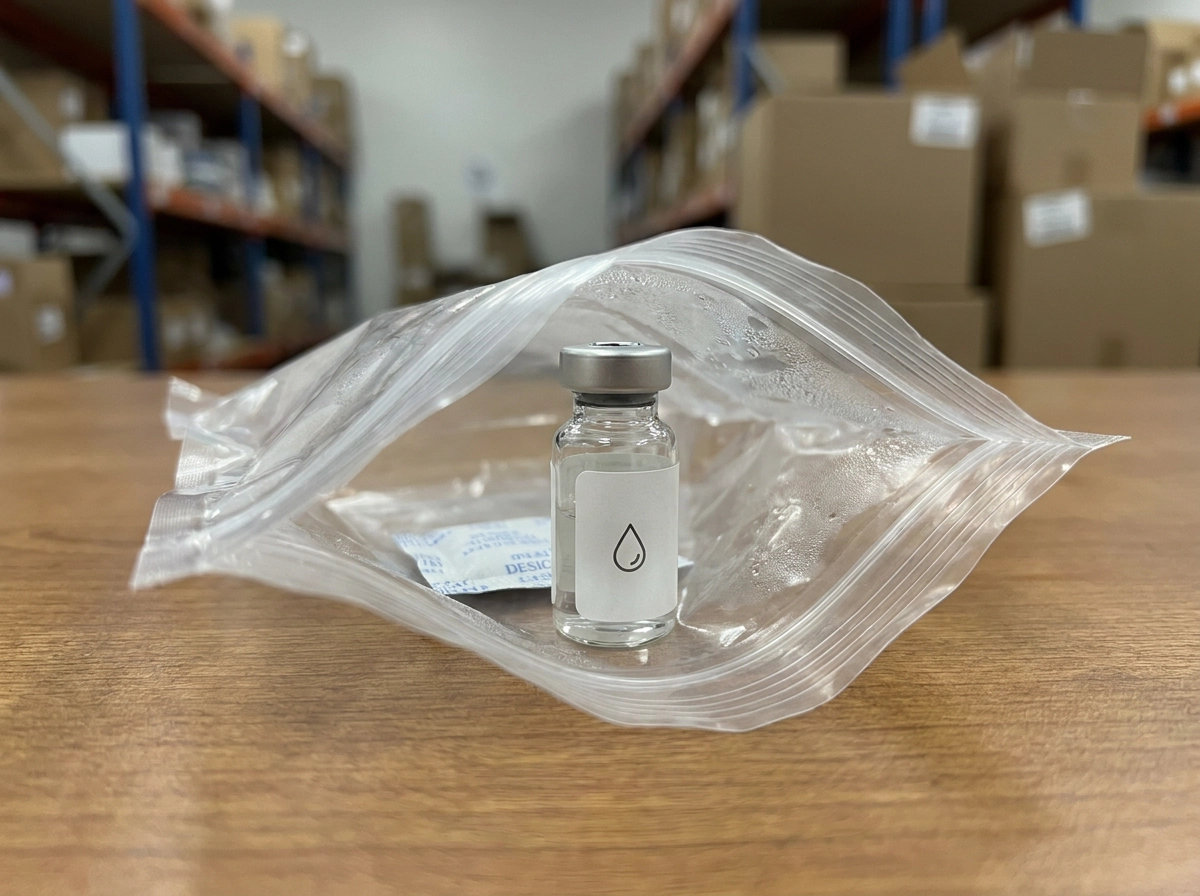
Temperature logging addresses cycle events, but a parallel risk operates through an entirely different mechanism. Even a vial maintained within its target temperature range throughout transit can arrive degraded if packaging allows moisture ingress. These are independent failure modes, and cold-chain documentation that covers only thermal excursions leaves the second pathway unaddressed.
Moisture initiates distinct degradation chemistry in peptides: hydrolytic cleavage of peptide bonds, oxidation, and aggregation can all proceed under conditions that a temperature logger would record as compliant. Lyophilized peptides are disproportionately vulnerable. The freeze-drying process produces a highly porous matrix with substantially increased surface area, enabling rapid reconstitution but also rapid moisture uptake. Even trace water absorption, in some formulations as little as 1-3% w/w, is sufficient to initiate these pathways faster than equivalent exposure would in a liquid or denser solid formulation.
Condensation compounds the risk at a specific point in transit: when a cold-packed shipment moves through a warmer ambient environment. Loading dock handoffs and customs facility staging are the highest-exposure moments, as warm humid air contacts cold surfaces and deposits moisture directly onto packaging seals that may not be fully hermetic under repeated handling.
Quality dispatch documentation should specify moisture-barrier packaging (foil-laminate pouches, hermetic seals) and desiccant inclusion with specified capacity. Researchers should request this from any supplier, not assume it as standard.
New Zealand's maritime climate means high ambient humidity in major transit hubs, a domestic shipment warrants the same moisture-barrier specification as international consignments, not a reduced standard justified by shorter transit time.
Customs Holding Periods: Why International Transit Introduces a Degradation Window
Moisture and humidity represent risks that operate throughout the supply chain. At the border, however, a separate and arguably more significant variable enters the picture: regulatory custody.
International peptide shipments entering New Zealand are subject to biosecurity inspection by the Ministry for Primary Industries. Depending on the consignment's classification, documentation, and current border volumes, MPI may hold goods for examination before release. Holding periods are variable and not publicly specified; researchers should not assume a short window. During that time, the compound is in a border facility, not a controlled pharmaceutical storage environment. Temperature is not maintained to cold-chain standards; the vial sits at whatever ambient conditions the facility presents, with no refrigeration and no monitoring.
For liquid formulations especially, more vulnerable to hydrolysis than lyophilised powders, even a moderate uncontrolled hold represents a meaningful degradation event.
There is also a total-loss scenario. Peptide compounds that fall under the Medicines Act 1981 classification, or that attract scrutiny under NZ import rules, are subject to seizure. Seizure means the compound is destroyed or returned at the importer's expense. Every cold-chain measure the supplier applied becomes irrelevant.
Researchers evaluating where to source peptides domestically should treat customs exposure as a core cold-chain variable, not a separate logistics footnote. For thermally sensitive compounds, the border is the highest-risk point in the entire international chain.
What Domestic NZ Supply Solves, and What It Does Not
Eliminating border exposure removes the highest-risk point in the international chain. That said, removing customs exposure does not remove cold-chain risk altogether, and that distinction matters for how researchers evaluate domestic procurement.
A domestic order has a categorically shorter transit window than an international shipment compounded by a customs hold.
The reduction in transit time is real. The assumption that domestic automatically means adequate is not.
A poorly packed domestic shipment, without insulation, without desiccant, and without temperature monitoring, can still expose a thermally sensitive compound to conditions sufficient to compromise integrity before the vial is opened. The shorter window reduces risk; it does not eliminate it. Researchers buying peptides online in NZ from a domestic supplier should still request the same dispatch documentation they would demand from an international source: packaging format, desiccant inclusion, and whether the formulation type received appropriate cold-chain handling.
There is a further documentation advantage that domestic stock enables. When a supplier holds domestic inventory, there is greater opportunity for the dispatched lot to match the COA on file, a documentary advantage researchers should confirm by asking directly whether the COA relates to the specific lot being dispatched.
Dispatch Documentation Checklist: What to Request Before Your Shipment Leaves
Knowing that domestic supply reduces but does not remove transit risk, the next step is operationalising that understanding into specific requests you make before any order leaves a supplier's facility.
Temperature range specification. Ask for the documented target temperature range for your specific formulation type. Lyophilized powders and reconstituted liquids have different thresholds; a single blanket cold-chain claim across both is not adequate documentation.
Packaging protocol disclosure. Request confirmation of moisture-barrier materials (foil pouches or hermetic seals), desiccant inclusion, and insulation format (dry ice, gel packs, or insulated liner). These should be stated explicitly, not implied by a general assurance of "careful packing."
Temperature monitoring confirmation. For thermally sensitive compounds, ask whether a continuous data logger is included with the consignment. A logged temperature record is verifiable; a verbal assurance of cold packing is not. For high-value or time-sensitive research procurement, the distinction matters.
COA batch matching. Confirm the Certificate of Analysis relates to the specific lot being dispatched, not a representative sample from the same product line. Ask who produced the certificate — an independent laboratory or the manufacturer's own — so you know what weight to give it, and check that it covers the batch you are actually receiving.
Dispatch timing and transit leg disclosure. Ask for the number of courier handoff points, the expected transit window, and which leg carries the highest thermal exposure risk. More handoffs mean more cumulative exposure and more points at which monitoring continuity can break down.
Domestic stock confirmation. For injectable peptide research in NZ, confirm whether the supplier holds physical domestic stock or is drop-shipping from an overseas warehouse. Same-day or next-day dispatch from local inventory represents a fundamentally different cold-chain risk profile than an international consignment routed through a border facility.
Procurement Verification as a Research Practice
The checklist in the preceding section defines what to request. This closing point is simpler: whether you request it determines whether the procurement meets research standards.
Closing that gap requires both elements together. Batch-specific testing establishes identity and purity at source. Verifiable dispatch documentation establishes handling conditions in transit. Neither substitutes for the other, and a supplier who provides one without the other is leaving a material gap in the evidentiary record.
The domestic-supply advantages established above are real; they do not replace documentation review. The most efficient filter at the procurement stage is straightforward: request cold-chain documentation before placing an order. A supplier's response reveals whether their operational standards are consistent with their purity claims.
Southern Labs holds domestic NZ stock and publishes the manufacturer's batch COA by lot number for every product it supplies. Researchers reviewing product-level batch specifications can confirm what documentation accompanies an order before placing one.
Conclusion
Peptide integrity is not established by a certificate alone; it is built across every stage from synthesis to delivery. Four principles define a defensible procurement standard: batch-specific documentation tells you what was tested and by whom, verified dispatch documentation confirms how a compound was handled in transit, thermal vulnerability varies by formulation and must inform storage decisions immediately on receipt, and domestic supply reduces risk without eliminating the need for documentation review.
Rigorous procurement is not administrative overhead; it is research protection. The data your study produces is only as reliable as the compounds it depends on. Confirm the documentation, then confirm the science.